 The Tiny Cart
How to Build a Morning Routine for Kids Without Constant Reminders
If mornings feel like a chain of repeated prompts, the problem usually is not motivation. It is invisibility.
Kids do better when the routine lives outside the parent. If every step stays inside your voice, you become the checklist, the timer, and the transition cue. That is exhausting for everyone.
What Makes Morning Routines Break Down
- Too many words. “Get dressed, brush teeth, pack backpack, hurry up” becomes background noise.
- No stable order. If the sequence changes every day, kids have nothing to memorize.
- Too many tasks at once. Children hear the first thing and lose the rest.
- No visible finish line. If the routine never looks complete, they keep needing adult confirmation.
The Routine Structure That Usually Works Better
1. Keep the order the same every day
Wake up, get dressed, brush teeth, eat, shoes, backpack, out the door. The exact steps can vary, but the order should be steady enough that the sequence becomes familiar.
2. Make the steps visible
Visual routines reduce the need for repeated verbal reminders. Even early readers can follow a short, clearly laid out sequence better than a running stream of spoken instructions.
3. Keep each line small
“School-ready” is too vague. “Get dressed” and “brush teeth” are easier to complete independently.
4. Add responsibility slowly
Morning success usually improves when routines come first and responsibility grows second. Do not introduce five self-management goals at once.
How to Make the Routine Feel More Independent
- Use the same language every day.
- Point to the next step instead of re-explaining the whole routine.
- Let the child check off completed steps whenever possible.
- Keep one column for parent notes, because real life is never perfectly repeatable.
The point is not to create a robotic household. It is to reduce friction so the family can move through the same hard hour with less noise and less nagging.
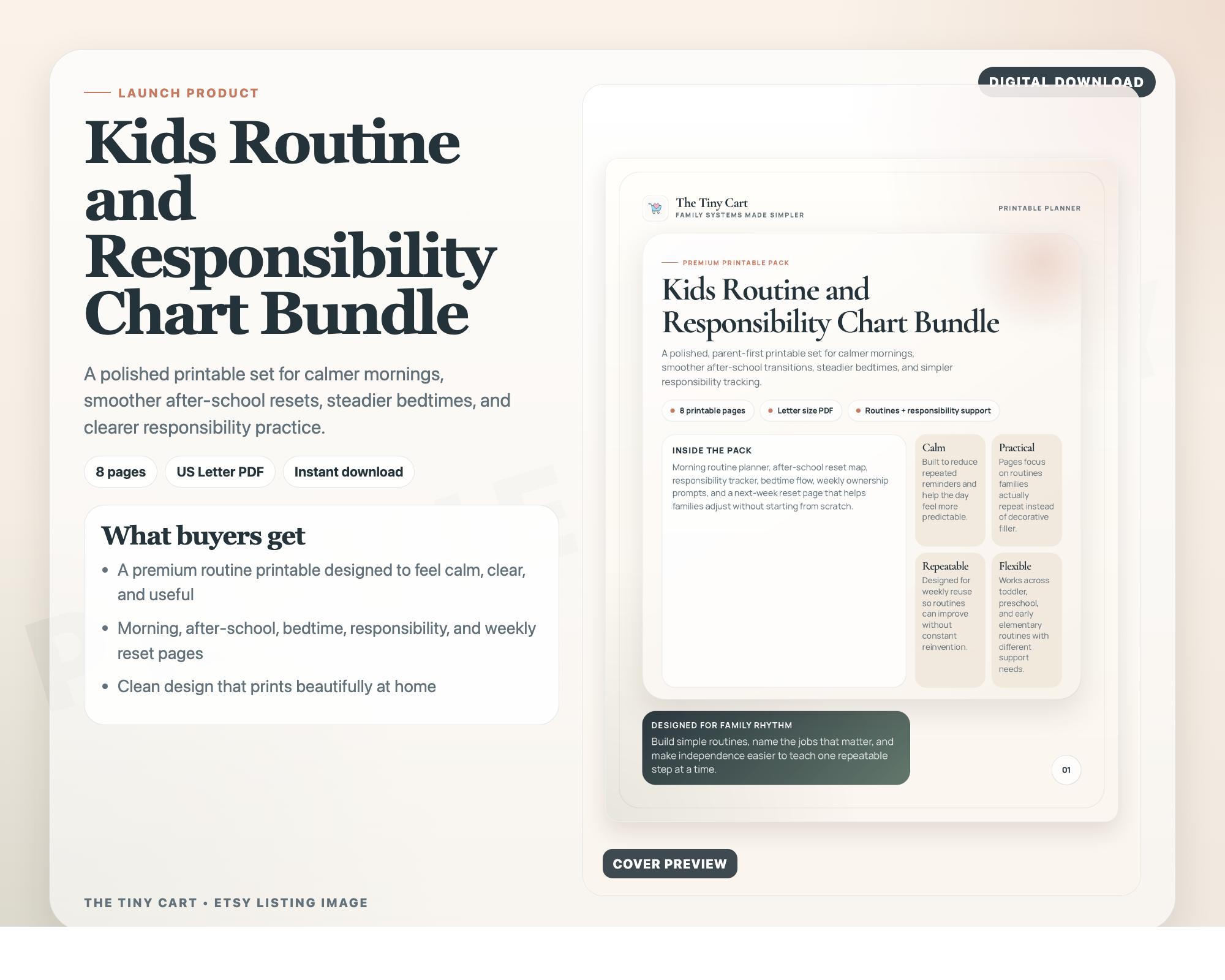
Matching Printable: Kids Routine and Responsibility Chart Bundle
This printable was built around smoother mornings, steadier after-school transitions, calmer bedtimes, and visible responsibility pages that children can actually follow.
See the printable →Start With One Routine, Not Three
If mornings are the pain point, begin there. Do not build a perfect bedtime routine, reward system, and chore map on the same day.
One visible routine that actually gets used is worth more than a beautiful set of systems nobody looks at next week.